
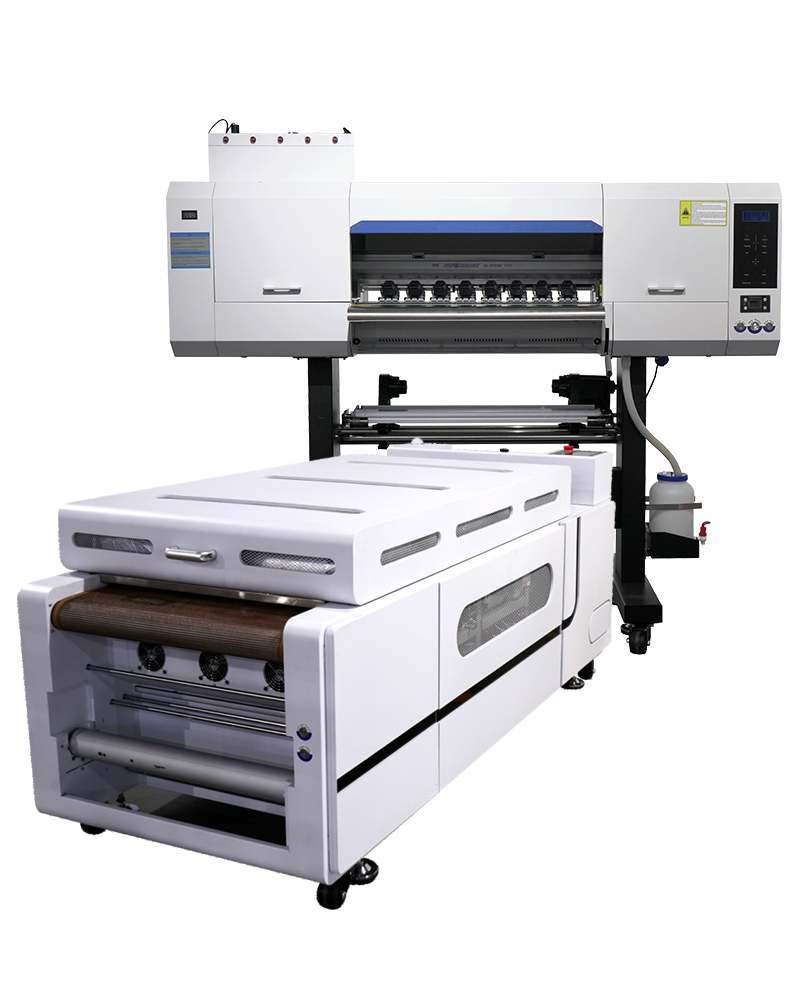
The short answer
For a standard chest print, the ink, film and powder on one shirt usually cost roughly $0.70 to $1.50 in materials. That is the range given by several independent supplier guides, and it is the honest answer: the exact number depends on how big the design is, how much white ink it uses, and how much film you waste between designs.
What is not in that number: the blank shirt, your time, the printer, the heat press, and electricity. A shirt you sell for $20–$25 is mostly blank garment, labour and margin — the DTF consumables are the small part. That is why DTF works for small orders: the cost per shirt barely moves whether you print one shirt or fifty.
What goes into the cost of one shirt
Three consumables, and only three, are used up on every print:
- Film — the PET sheet the design is printed on.
- Ink — CMYK plus white.
- Powder — the hot-melt adhesive that bonds ink to fabric.
Everything else — printer, shaker, heat press, RIP software — is a one-off cost, covered in our cost guide (blog #4). This article is only about the materials that disappear with each shirt.
Film: the easiest cost to work out
Film is sold by the roll, and the maths is simple because you know exactly how much film a design uses.
DPI Shop’s DTF Instant Hot Peel Film is $92.22 for a roll 23.6 inches wide and 328 feet long. That is 23.6″ x 3,936″ — about 645 square feet of film on one roll.
A standard full-chest print is about 12″ x 12″, which is 1 square foot. So the film for one chest print costs:
$92.22 ÷ 645 sq ft = about $0.14 per print
That assumes no waste, which is not realistic — you lose film to trimming, test prints and gaps between designs. With normal waste, call it $0.15–$0.25 for a chest print. A small left-chest logo, about 4″ x 4″, uses about a ninth of the film, so roughly $0.02–$0.05.
Published supplier estimates agree with this range: InkSonic puts film at $0.30–$0.50 per shirt, and another supplier guide (EZ DTF Maker) puts it at $0.35–$0.70. Those guides assume more waste and smaller rolls than DPI Shop’s 328-foot roll, which is why their film figure is higher than the straight maths above. The truth for your shop is somewhere between: buy film by the roll, waste as little as you can, and the film cost per shirt is small.
This is also where gang sheets earn their money: packing several designs onto one sheet means almost no film is wasted. Our gang sheet guide (blog #8) works through that.
Ink: the biggest and most variable cost
Ink is the biggest consumable cost, and the hardest to pin down, because it depends on the design. A white logo on a black shirt uses far more ink — mostly white — than a thin line drawing on a white shirt. White ink is the expensive part: it goes down as a full underbase layer behind the colours, so a dark garment can use several times more ink than a light one.
DPI Shop’s high performance DTF ink is $34.80 per litre, white and CMYK, so a full set of five litres (CMYK + white) is $174.00.
What do other sellers report per shirt? InkSonic estimates ink at $0.60–$1.00 per shirt. EZ DTF Maker estimates $0.20–$0.40. MyDesigns puts total consumables (ink, film and powder together) at $0.50–$1.50 for an A4-sized transfer. Those ranges disagree because the designs disagree — heavy white coverage costs more, light designs cost less.
The honest way to get your own number: your RIP software can report how much ink a job used. Print ten of your typical designs, note the ink used, and divide by ten. Until you do that, budget $0.50–$1.00 per shirt for ink on a normal full-colour chest print, more for white-heavy designs on dark garments, less for small or light designs.
One practical tip from the maintenance side: white ink is also the ink that clogs. Pigment settles, heads dry out, and a clogged head wastes ink on cleaning cycles. The daily white-ink routine in our maintenance guide (blog #2) — agitate the white ink, print a nozzle check every morning, clean the wiper and capping station — is not just about the printer lasting longer. It is about not pouring ink down the waste bottle.
Powder: the smallest cost
Powder is the cheapest of the three. DPI Shop’s DTF powder is $14.36 for 1 kg (2.2 lb). Only the powder that sticks to wet ink is used — a powder shaker recycles the rest — so a kilo goes a long way.
Supplier estimates put powder at $0.05–$0.20 per shirt (EZ DTF Maker $0.05–$0.12; InkSonic $0.10–$0.20). At DPI Shop’s price of $14.36 a kilo, even the top of that range means one kilo covers roughly 70–150 shirts, depending on design size and how much powder your shaker recovers. Powder is the last thing to worry about in your cost per shirt — but it is the first thing to get right for adhesion, because too little powder is why transfers peel. Our peeling guide (blog #6) covers that.
Putting it together: cost per shirt
For a standard full-chest print on a dark shirt, using DPI Shop consumable prices and the published ranges above:
| Consumable | DPI Shop price | Typical cost per shirt |
|---|---|---|
| Film (23.6″ x 328′ roll) | $92.22/roll | $0.15–$0.30 |
| Ink (CMYK + white) | $34.80/L | $0.50–$1.00 |
| Powder | $14.36/kg | $0.05–$0.20 |
| Total consumables | about $0.70–$1.50 |
For a small left-chest logo, roughly half that. For a big back print with heavy white coverage, roughly double the ink — so $1.20–$2.00.
Compare that with the other numbers shops quote: MyDesigns says $0.50–$1.50 in consumables for an A4-sized transfer; EZ DTF Maker says $0.70–$1.20 per print all in; InkSonic’s ranges add up to about $1.00–$1.70. They all land in the same place, which is reassuring — nobody’s consumables cost per shirt is $5, and nobody’s is $0.10.
Buying transfers vs printing in-house
Many small shops do not print at all — they order transfers from a supplier and press the shirts in their own store. That is a sensible way to start: no printer to buy, no maintenance, no ink to clog. A bought transfer typically costs $2–$5 per shirt (MyDesigns), and a 22-inch gang sheet from a supplier runs from about $0.75 per inch of length (DTF Database, November 2026).
Printing in-house, the consumables on the same shirt cost roughly $0.70–$1.50, as worked out above — so you save roughly $1–$3.50 per shirt on materials. But you pay for the machine: the EQ400-A is $16,008, or $25,708.50 with the DY700-A powder shaker, plus a heat press and RIP software. At a saving of, say, $2 a shirt, the printer alone takes about 8,000 shirts to pay back — so the decision is about volume and control, not just the per-shirt number.
What tips it for most shops is not the saving but the control: your own designs printed the same day, no waiting on a supplier, no wondering whether a peeling print was your press or their transfer (see blog #6), and the freedom to print one shirt at a time. If you are pressing bought transfers today and the orders keep coming, work out how many shirts a month you press — that number, times the saving per shirt, is your honest answer to whether printing in-house pays.
What the consumables cost does NOT include
Do not price a shirt at $1.50 and call it profit. The consumables are the small part. A real price per shirt also has to cover:
- The blank garment — usually $3–$8, and the biggest single cost.
- Your time — designing, printing, powdering, curing, pressing, packing. Even at a modest hourly rate, 10 minutes of labour is several dollars.
- The machine — the printer, shaker and press wear out and need maintenance. Spread their cost over the shirts they print.
- Waste and mistakes — misprints, test prints, a shirt pressed wrong. Budget for it, because it happens.
- Selling costs — packaging, shipping, platform fees.
One supplier’s rule of thumb, quoted in several business guides, is to price a custom shirt at roughly three times its full cost (blank + consumables + labour). A shirt that costs you $6 all in sells for around $18. Treat that as a starting point, not a rule — your market and your quality decide the price, not a formula.
A real-world check from a print shop cost guide (Conquer Printing): a small DTF order usually runs $8–$20 per shirt once you count the blank, the transfer and the press time, and 50 or more of the same design drops that to $4–$10 a shirt. That is the price a customer pays, not the consumables cost — but it shows why DTF wins on small orders and screen printing wins on big ones: DTF has no setup cost to spread, so the first shirt costs almost the same as the fiftieth.
How to cut the cost per shirt without cutting quality
- Use gang sheets. Fill the film, don’t waste it. Several small designs on one sheet share the film cost. See blog #8.
- Buy consumables by the roll and the litre, not by the sheet and the bottle. DPI Shop’s film is $92.22 for a 328-foot roll and ink is $34.80 a litre — buying in bulk is where the per-shirt cost comes down.
- Keep the white ink moving. A clogged head wastes ink on cleaning cycles and ruins film. The maintenance routine in blog #2 pays for itself in ink alone.
- Don’t over-ink. More white is not always better — too much white makes a stiff, crack-prone print as well as a dearer one. Our peeling guide (blog #6) explains the cracking problem.
- Price by design size. A 4-inch logo and a 12-inch back print do not cost the same to make. Charge for the size, not a flat rate.
Frequently asked questions
How much does DTF printing cost per shirt in materials?
Roughly $0.70–$1.50 in ink, film and powder for a standard chest print, using DPI Shop’s prices and published supplier ranges. Small designs cost less, big white-heavy designs cost more.
What costs more, the ink or the film?
The ink, usually. Film is about $0.15–$0.30 a print; ink is $0.50–$1.00 on a normal full-colour design, and white ink is the biggest share of that.
Is DTF cheaper than screen printing per shirt?
For small orders, yes — screen printing pays a setup cost (a screen for every colour) before the first shirt, so a 12-shirt order is expensive. For large runs of the same design, screen printing is still cheaper per shirt.
How much does it cost to start DTF printing?
The machine and setup are covered in blog #4: the EQ400-A is $16,008, or $25,708.50 with the DY700-A powder shaker, plus a heat press and RIP software. The consumables to get going — a roll of film, a set of inks and a kilo of powder — are a few hundred dollars on top.
Can I see a sample before I buy?
Yes. Contact DPI Shop at info@dpishop.com or (469) 515-1760 and ask for a free sample print on the EQ400-A using your own design — about a 10-minute demo, no pressure to buy.
Contact: DPI Shop, Plainsboro, NJ. info@dpishop.com | (469) 515-1760 | dpishop.com

