
Intro
DTF film and UV DTF film sound almost the same, and both let you print a design onto a film and transfer it to a product. But they are not interchangeable, and picking the wrong one is the most common film mistake we see at DPI Shop in Plainsboro, NJ. The short version: DTF film is for fabrics, UV DTF film is for hard surfaces. This guide explains why, film by film, so you buy the right roll the first time.
The difference in one line
- DTF film: a single PET film for T-shirts and other fabrics. You print on it, add hot-melt powder, cure it with heat, heat-press it onto the fabric, and peel it while it is still hot.
- UV DTF film: a two-part A and B film system for hard surfaces. You print on the A film with UV-curable ink, cure it with UV light, laminate it with the B film, then press it onto the surface by hand. No heat press, no powder.
DTF film vs UV DTF film at a glance
| DTF film | UV DTF film | |
|---|---|---|
| Made for | Fabrics | Hard, smooth surfaces |
| Typical items | T-shirts, hoodies, tote bags, caps, sportswear | Tumblers, mugs, glass bottles, acrylic, phone cases, metal, ceramic, wood, packaging |
| Film system | Single PET film, 23.6" x 328′ roll | Two-part A and B film system, 23.6" x 328′ roll |
| Thickness | 80 microns | 80 microns |
| Ink | Water-based pigment DTF ink, CMYK + white | UV-curable ink, CMYK + white + varnish |
| Adhesive | Hot-melt adhesive powder, applied after printing | Adhesive built into the film system; the B film picks up and holds the printed design |
| Curing | Heat, in an oven or dryer, melts the powder | UV light cures the ink as it prints |
| Application | Heat press, typically 300°F–330°F (150°C–165°C) for 10–15 seconds | Press on by hand, no heat press |
| Peel | Hot peel, within 2–5 seconds after pressing | Peel away the transfer film after pressing it onto the surface |
| Finish | Soft, flexible print that stretches with the fabric | Raised, glossy finish possible with varnish; crystal-clear transfer with clean edges |
| Price on dpishop.com, checked 2026-11-18 | $92.22 (was $134.00) | $251.43 (was $420.00) |
What DTF film is, and how it works
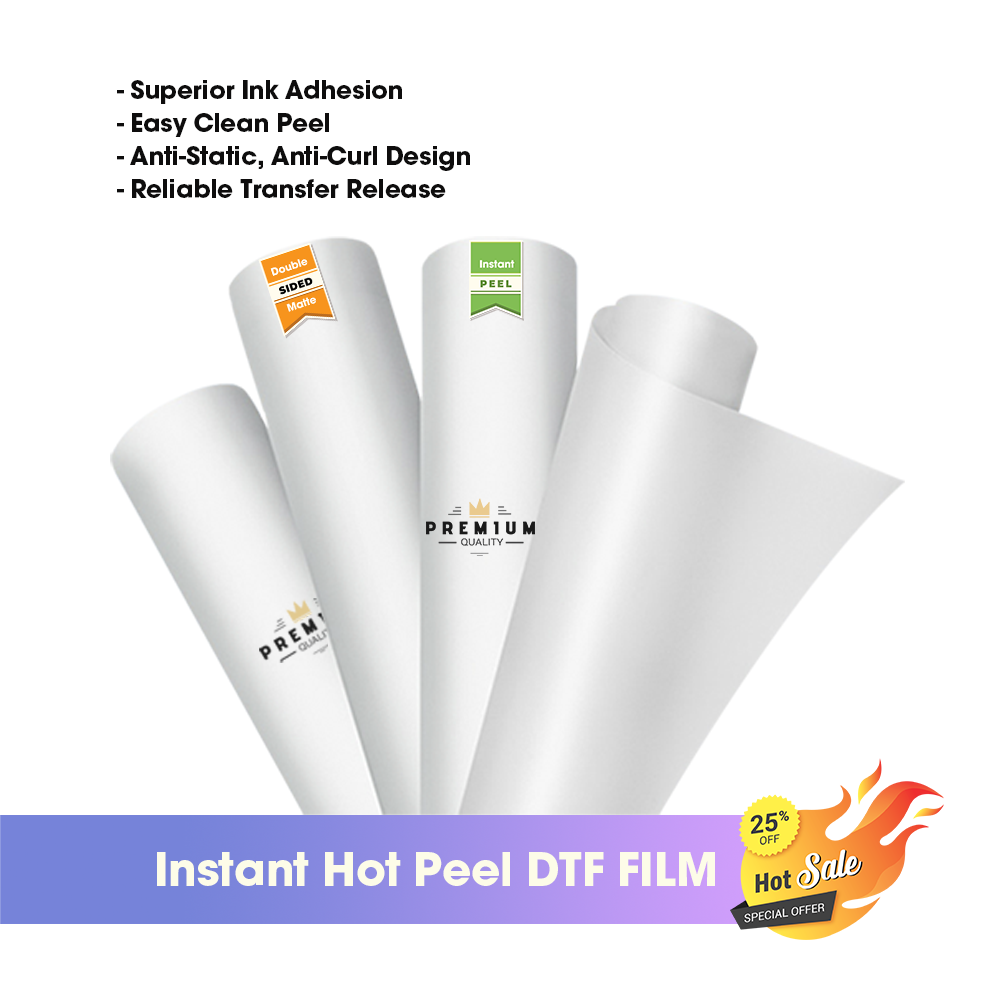
DPI Shop’s DTF film is an instant hot-peel, double-sided coated PET transfer film, 23.6" x 328′, 80 microns thick. Both sides are frosted, though only one side is printable; the matte back gives extra friction so the film does not slip on the printer rollers and reduces static.
The steps, in order:
- Print the design in reverse onto the film with DTF ink, CMYK plus a white ink underbase so colours pop even on dark shirts.
- While the ink is still wet, apply hot-melt adhesive powder, shake off the excess, and cure it so the powder melts into an adhesive layer.
- Heat-press the transfer onto the garment, then peel the film while it is still hot, within 2–5 seconds, for faster production.
It works on cotton, polyester, blends and other fabrics, in light and dark colours, with no pre-treatment of the garment. The finished print is thin, soft and flexible, so it moves and stretches with the fabric instead of feeling like a heavy plastic layer.
What UV DTF film is, and how it works

DPI Shop’s UV DTF film is an A and B film system, also 23.6" x 328′ and 80 microns thick. The A film and the B film have different jobs and are used together:
- A film: the printable film. It has a specially coated printable side and a non-printing backside. You print the design onto it with UV-curable ink, often with white ink and a clear varnish layer, and the UV light cures the ink as it prints.
- B film: the laminating film. It has an adhesive side that bonds with the printed design and a backing/release side. Laminating the printed A film with the B film picks up and holds the design for transfer.
The steps, in order:
- Print on the A film with a compatible UV printer. The UV ink is cured with ultraviolet light.
- Laminate with the B film over the printed design.
- Apply without heat: place the design on a clean, dry hard surface, press firmly to ensure adhesion, and peel away the transfer film as directed.
No heat press is needed, which is why UV DTF works for items that cannot go into a heat press, like bottles and curved tumblers. The result is a sticker-like transfer with strong adhesion, a crystal-clear finish, and a raised or glossy feel when varnish is used.
Which film should you buy?
- Choose DTF film if most of your orders are custom apparel: T-shirts, hoodies, team uniforms, workwear, tote bags and caps. If the product is fabric and it goes through a heat press, DTF film is the right roll.
- Choose UV DTF film if you sell personalised gifts and promotional products: tumblers, glass bottles, mugs, phone cases, acrylic signs, metal, ceramic, wood and packaging. If the product is a hard, smooth surface and it cannot go into a heat press, UV DTF film is the right roll.
- Consider both if you want to offer apparel and hard goods to the same customers. Many print shops start with one and add the other as demand grows.
Common mistakes to avoid
- Using DTF film on a hard surface, or UV DTF film on fabric. DTF transfers are not designed for hard goods, and UV DTF transfers are not designed for garments.
- Using the wrong ink for the film and printer. DTF ink is water-based pigment ink; UV DTF ink is UV-curable. Never put DTF ink in a UV printer or UV ink in a DTF printer, and do not mix ink brands or formulations in the same system.
- Skipping the powder step on DTF film, or skipping the B film lamination on UV DTF film. Without powder, a DTF print has no adhesive to bond to fabric. Without the B film, a UV DTF design has nothing to pick it up and hold it for transfer.
- Peeling DTF film cold. DTF film from DPI Shop is hot-peel: remove it immediately, within 2–5 seconds after pressing.
- Applying UV DTF to a dirty, wet or textured surface. The surface should be clean, dry and smooth, and always test a new substrate before a large production run.
- Storing film badly. Both films are best kept in a cool, dry environment below 77°F (25°C) and 30%–60% relative humidity, with a shelf life of usually 12 months in original, unopened packaging.
Bottom line
Do not choose a film by its name — choose it by the surface you are decorating. If it is fabric, use DTF film, powder and a heat press. If it is a hard surface, use UV DTF A and B film, UV ink and hand pressure. Get that one decision right and the rest of the process follows.
DPI Shop supplies both: DTF Instant Hot Peel Film 23.6" x 328′ at $92.22 on dpishop.com on 2026-11-18, and UV DTF A&B Film 23.6" x 328′ at $251.43. Not sure which film fits your printer or your next order? Contact DPI Shop at info@dpishop.com or (469) 515-1760.

